
“COFI incorporates families and family goals within the model. And that’s really important, because people are complex, and families are part of organizing.”
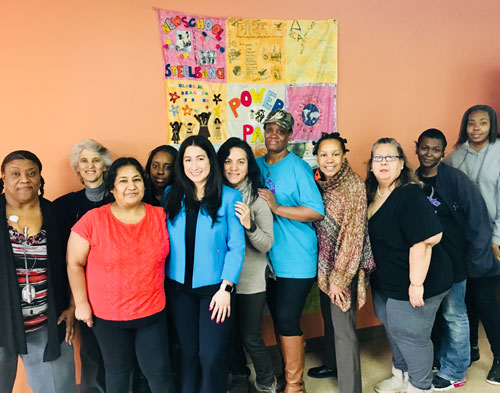
Meet Jennifer! She’s a researcher and the secretary of COFI’s Board of Trustees.
She has held a deep respect for COFI and POWER-PAC IL since 2014 when she first began learning from and working in partnership with staff and parents as a graduate student.
“I don’t come from an ‘organizing’ family, though, and much of what I know at a practical level is from being so involved with COFI and POWER-PAC IL,” she said.
Growing up, Jennifer said organizing was not something people in her immediate community and around her were doing, or something she was aware of. She comes from an immigrant family and said the overarching message was often: “Keep your head down, work hard, and don’t call too much attention to yourself.”
As she pursued her graduate studies, she learned more about organizing theory and started to notice a gap. She read a lot about charismatic organizing leaders who were typically men and noticed less literature about women-led organizing.
“Women organizers have been there forever. Women who were enslaved were organized, washerwoman were organizing, and some of the first worker unions were formed by women,” she said.
Meeting COFI
It almost seemed like fate that, as a fellow at the Center for Urban Research and Learning at Loyola University, she was put on a project funded by the Chicago Foundation for Women (CFW). The project collaborated and supported CFW grantees to increase their capacity to do research—coincidentally CFW has been funding COFI since its beginning.
“I was curious about how COFI fit in the ecosystem of organizing and the importance of moms and grandmothers organizing and really felt like this type of organizing didn’t get the recognition it deserved,” she said.
Even after the project, Jennifer chose to focus her doctoral dissertation on parents organizing through The COFI Way. She said, broadly, the study examined how organizing shaped family life and how family life shaped organizing. She interviewed almost 50 staff and parents at COFI, engaging in participant observations of The COFI Way training, campaign meetings, and staff meetings for 15 months.
“I was a fly on the wall, but in many ways, I was also a participant,” she said. “After, I remained connected as a supporter and champion of COFI’s work.”
One moment that captures the power of parents and families perfectly is when Jennifer joined COFI and POWER-PAC IL for their annual advocacy day, Moms on a Mission. She saw youth visiting the Capitol for the first time, parents telling their kids they could be lawmakers one day, parents guiding her like a lost visitor, and sharing their wisdom on how to tell their story connected to policy priorities.
“COFI incorporates families and family goals within the model. And that’s really important, because people are complex, and families are part of organizing.”
A Full-Circle Moment
Jennifer’s journey has also come full circle with the recently published, “If We Come Together, Then We Have Power” Snapshots of Organizing report. It was a participatory research project co-led by her and researchers at the NYU Metro Center and a design committee including COFI-trained parent leaders Rosazlia Grillier, Lettie Hicks, Felipa Mena, and Liliana Olayo, and COFI’s Executive Director Ellen Schumer. Parent leaders engaged in research ethics training and joined as co-investigators to lead interviews and focus groups. For a first-generation college graduate who said she didn’t come from an organizing background, it was powerful to see community members leading the research and using the learnings to advance their organizing efforts.
“I have learned so much from them,” she said.
Now, her dream is that every parent who wants to organize has access, and every child grows up learning their rights and power alongside their families.
“COFI kids are lucky to observe the wonderful work that their parents are doing. I’ve interviewed many of them, and I’ve heard the stories of reflection, change, and awe of their moms and dads and how they believe they can create change, too.”
<< Back to 30 Stories
Isaiah’s Story >>
 English
  Spanish